
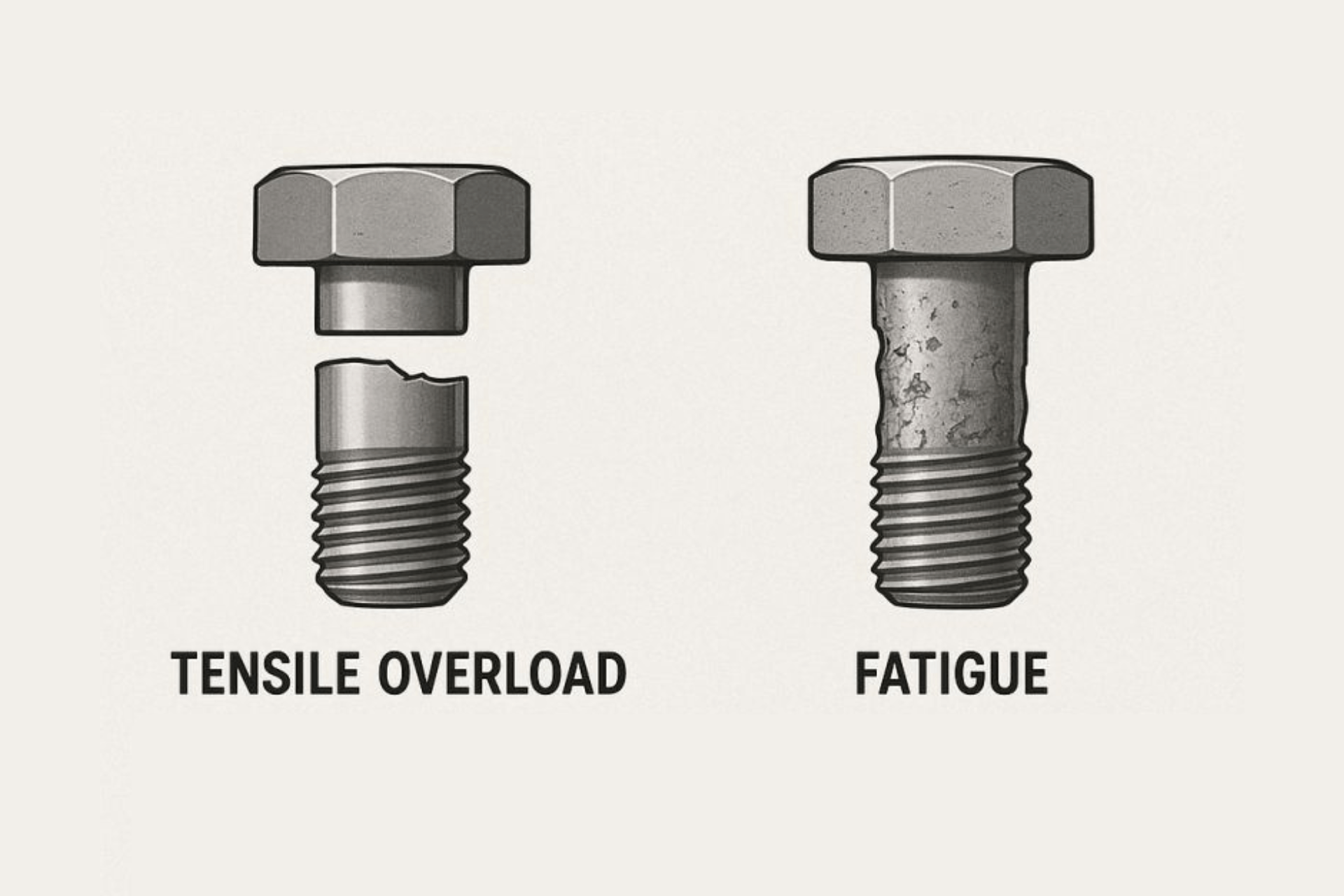
In industrial systems, fasteners rarely fail because they were overloaded once. Instead, failure usually occurs after thousands or millions of small load cycles that slowly damage the fastener over time. This phenomenon, known as fatigue failure, is one of the most critical—and misunderstood—issues in fastening.
At RealBolt, we design and supply fasteners with fatigue resistance in mind, because real-world loads are rarely static.
What Fatigue Failure Really Is
Fatigue failure occurs when a fastener is subjected to repeated or fluctuating loads below its maximum strength. Each load cycle creates microscopic cracks within the material, often starting at threads or surface imperfections.
These cracks grow incrementally with every cycle until the remaining cross-section can no longer support the load. The final fracture often appears sudden, even though the damage has been accumulating for a long time.
Fatigue is a silent process that gives little warning before failure.
Why Fasteners Are Especially Vulnerable to Fatigue
Fasteners naturally experience stress concentration at thread roots, under bolt heads, and at contact surfaces. When preload is insufficient, the fastener carries fluctuating loads directly, greatly increasing fatigue stress.
Vibration, thermal expansion, and dynamic forces further amplify fatigue damage. Even high-strength fasteners can fail prematurely if fatigue is not properly addressed during design and installation.
Strength alone does not prevent fatigue failure.
How Design and Installation Influence Fatigue Life
Proper preload significantly improves fatigue resistance by keeping joint members clamped together. When the joint absorbs most of the load, stress variations in the fastener are minimized.
Smooth surface finishes, correct thread profiles, and proper alignment also reduce stress concentrations. Small installation errors can dramatically shorten fatigue life.
Fatigue performance begins with correct design and installation.
Material Choice and Heat Treatment Matter
Different materials respond differently to cyclic loading. Proper heat treatment improves fatigue strength by optimizing hardness and microstructure.
Inconsistent material quality or poor heat treatment introduces internal defects that accelerate crack formation. This is why fatigue resistance depends as much on manufacturing quality as on material selection.
Controlled processes are essential for long-term performance.
How RealBolt Addresses Fatigue-Critical Applications
RealBolt fasteners are manufactured with controlled materials, precise threading, and verified strength grades to improve fatigue performance. Our focus on consistency helps reduce variability that leads to early fatigue failure.
By supporting proper selection and application, RealBolt helps industries extend fastener life, improve safety, and avoid costly unexpected failures.