
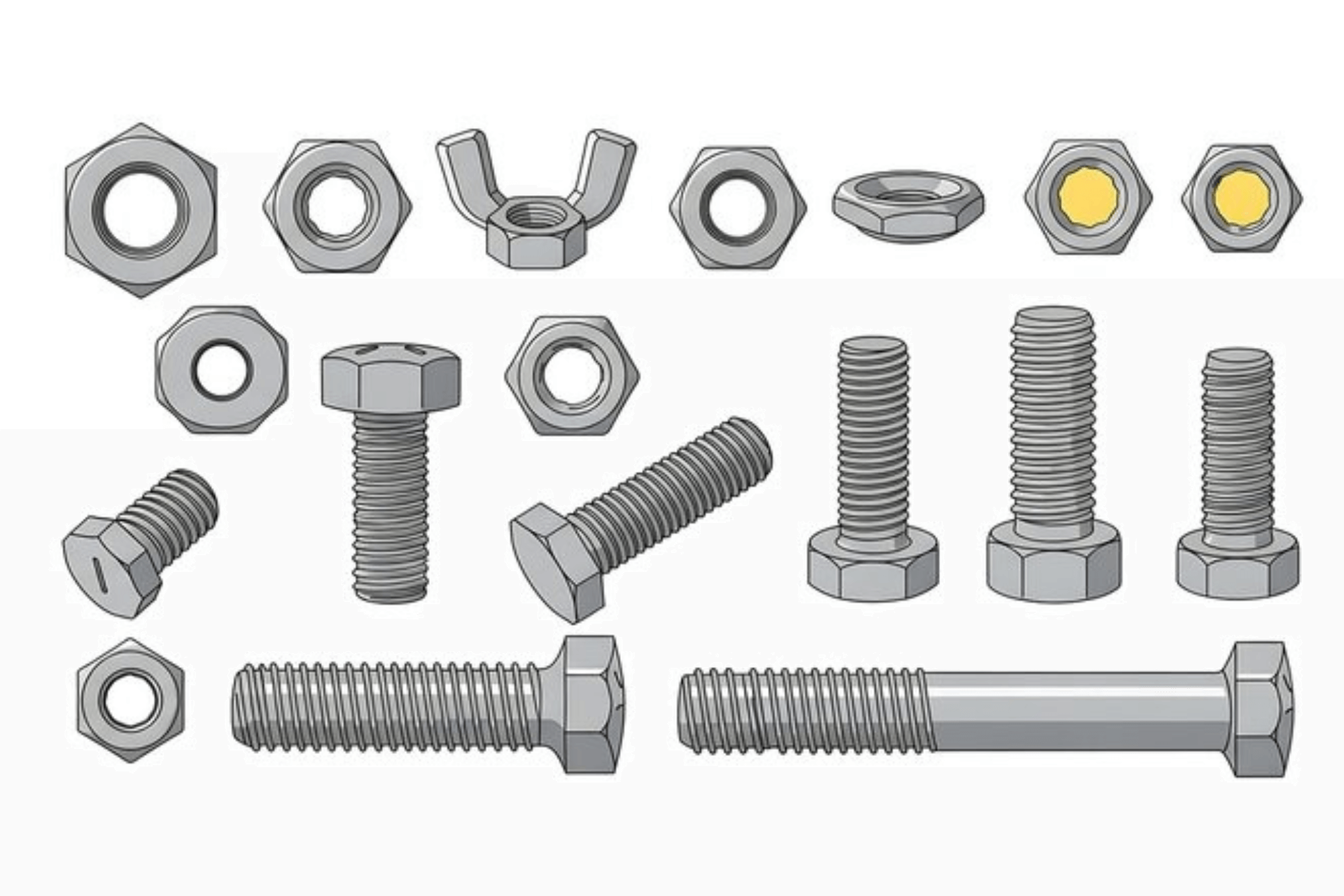
Bolts are essential mechanical fasteners used to join two or more components securely. They are widely used across construction, manufacturing, automotive, infrastructure, and heavy engineering industries. Choosing the correct type of bolt is critical for ensuring strength, safety, and long-term performance of any assembly.
Different bolt types are designed based on head shape, threading, load capacity, and application requirements. Understanding these variations helps in selecting the right bolt for specific industrial needs.
Hex Bolts
Hex bolts are the most commonly used bolts in industrial and structural applications. They feature a six-sided head that allows easy tightening using standard tools such as spanners or wrenches. Hex bolts are typically used with nuts and washers to create strong, removable joints.
These bolts are widely used in construction frameworks, machinery assembly, and heavy equipment due to their high strength and versatility. They are available in various materials, grades, and finishes to suit different load and environmental conditions.
Carriage Bolts
Carriage bolts are identified by their rounded head and square neck beneath the head. The square neck prevents the bolt from rotating when tightened, making them ideal for applications where access is limited to one side.
They are commonly used in wood-to-wood or wood-to-metal connections, such as furniture, fencing, and structural timber work. The smooth, domed head also provides a clean and finished appearance.
Flange Bolts
Flange bolts feature a built-in washer-like flange under the head. This flange helps distribute load evenly across the surface and reduces the need for a separate washer.
These bolts are widely used in automotive and industrial machinery applications where vibration resistance and load distribution are important. The integrated flange also helps protect surfaces from damage during tightening.
Anchor Bolts
Anchor bolts are designed to secure structures or equipment to concrete foundations. They are embedded into concrete and provide a strong anchoring point for columns, machinery, and structural supports.
Common types include L-shaped, J-shaped, and straight anchor bolts. They are widely used in construction, infrastructure projects, and industrial installations where stability and load transfer are critical.
Stud Bolts
Stud bolts are threaded rods with threads on both ends or along the entire length. They are typically used with two nuts and are ideal for high-pressure and high-temperature applications.
Stud bolts are commonly used in piping systems, flanges, pressure vessels, and oil & gas industries. Their design allows for uniform load distribution and easy maintenance in critical assemblies.
Eye Bolts
Eye bolts feature a looped head and are primarily used for lifting, rigging, and load handling applications. They provide a secure attachment point for ropes, chains, or hooks.
These bolts must be selected carefully based on load capacity and lifting angle to ensure safety. Eye bolts are widely used in material handling, construction sites, and industrial lifting operations.
U-Bolts
U-bolts are shaped like the letter “U” and are threaded on both ends. They are commonly used to secure pipes, tubes, or round objects to structures or supports.
They are widely used in plumbing, automotive suspension systems, and industrial piping installations. U-bolts provide strong clamping force and stability for cylindrical components.
Structural Bolts
Structural bolts are high-strength bolts designed for load-bearing structural connections. They are commonly used in steel structures, bridges, and heavy construction projects.
These bolts are manufactured to strict standards and are designed to withstand extreme loads and stress. Proper installation and torque control are essential to ensure structural integrity.
Conclusion
Understanding the different types of bolts is essential for selecting the right fastener for any industrial application. Each bolt type serves a specific purpose and offers unique advantages based on design, load capacity, and environment.
Choosing the correct bolt improves joint strength, enhances safety, and extends the lifespan of equipment and structures. For best results, always consider application requirements, material, grade, and industry standards when selecting bolts.